

· Johannes Millan · 6 min read
ADHD Hyperfocus at Work: Harness It Without Burning Out
Some of your best work probably happened during hyperfocus – a feature shipped in one unbroken sitting, a gnarly bug chased down for four hours straight. And some of your worst days probably did too: the same four hours poured into a refactor nobody asked for while three real deadlines quietly slipped.
That is the paradox of ADHD hyperfocus. It is not a lack of attention; it is attention with no steering wheel. The goal is not to summon more of it or to suppress it, but to aim it. For the broader set of routines this fits into, see our ADHD Productivity Guide; this article is specifically about working with hyperfocus instead of being dragged around by it.
Note: This is educational, not medical advice. If ADHD symptoms are disrupting your work, study, relationships, or safety, talk with a qualified clinician.
What ADHD hyperfocus actually is
Hyperfocus is a state of intense, sustained concentration on a task you find engaging, during which awareness of time, hunger, and surroundings drops away. In a study of more than 600 adults, researchers found that those with higher ADHD symptoms reported hyperfocus more frequently – across settings like screen time, hobbies, and schoolwork.1
Here is the part most advice misses, and it follows from how that focus works rather than from the study itself: hyperfocus does not lock onto what you should do; it locks onto what is interesting right now. It runs on the same dopamine-seeking wiring we unpack in escaping the dopamine trap. Understanding that lets you stop treating hyperfocus as random luck and start setting conditions that point it somewhere useful.
It is close to, but not the same as, the flow state developers chase. Flow is generally chosen and pleasant; hyperfocus can be involuntary and, on the wrong task, costly.
The two faces of hyperfocus
| Productive hyperfocus | Destructive hyperfocus | |
|---|---|---|
| Target | A task you chose that matters | A shiny tangent that just looks interesting |
| Output | Deep, high-quality work | Hours sunk, real priorities slipped |
| Exit | Planned stop, energy banked | Crash – skipped meals, missed meetings |
| After | Satisfied, recovered | Drained, behind, deflated |
Same underlying state, opposite outcomes. The only variables you control are what it latches onto and how you exit. The next two sections cover exactly those.
How to aim hyperfocus at the right work
You cannot reliably force hyperfocus, but you can stack conditions so that when it ignites, it catches on something you actually picked:
- Pre-decide the target. Choose the task before you sit down, while your prefrontal cortex is still in charge. Once hyperfocus engages, it will grab whatever is in front of you – so make sure the right thing is in front of you. The Eisenhower matrix is a fast way to pick the one task worth a long block.
- Make starting trivial. Hyperfocus follows engagement, and engagement follows starting. Lower the barrier: open the file, write one failing test, draft the first sentence. This also defuses the task paralysis that often sits between you and the work.
- Work at your peak. If your sharpest window is late morning, defend it. Aiming hyperfocus during a natural energy peak compounds the effect.
- Clear the runway. Close Slack, silence the phone, shut the spare tabs. An interruption during the ignition phase usually kills the whole session.
The aim is not more willpower. It is arranging the environment so the most stimulating thing in the room is also the thing you decided mattered.
Guardrails: getting out before you crash
The dangerous part of hyperfocus is not the entry – it is the exit, because the internal signals that normally say “you’re hungry / it’s late / that meeting started” are exactly what hyperfocus mutes. You have to outsource those signals to the environment:
- Hard-stop alarms. A timer you must physically get up to silence beats a gentle notification you will tune out.
- Bookend the block. Schedule the next commitment right after it. A 2 PM call is a far more reliable exit than your own intention to “stop around 2.”
- Keep fuel in reach. Water and a snack on the desk. Going hours without food or water can turn a great session into a rough evening.
- Drop a breadcrumb before you stop. Write one line – “next: wire up the error state” – so returning later costs seconds, not a cold restart. This is the same micro-handoff habit that protects working memory limits.
Pro tip: The goal of a guardrail is not to cut hyperfocus short. It is to make the boundaries external so the focus itself can be total inside them.
Recovering from a hyperfocus crash
Even a well-aimed session has a bill: a long stretch of intense focus can leave you depleted. Plan for the comedown instead of being ambushed by it.
- Bank a recovery buffer. Do not schedule demanding work right after a long block. Slot something low-stakes – email, a walk, admin – so the dip has somewhere to land.
- Be kind about the crash. Feeling foggy after hours of intense focus often just means you skipped food, water, or movement – it is not a character flaw. Eat, hydrate, move.
- Log what triggered it. Over a few weeks you will spot which task types reliably pull you into productive hyperfocus – and which ones are reliable traps to fence off.
How Super Productivity supports this
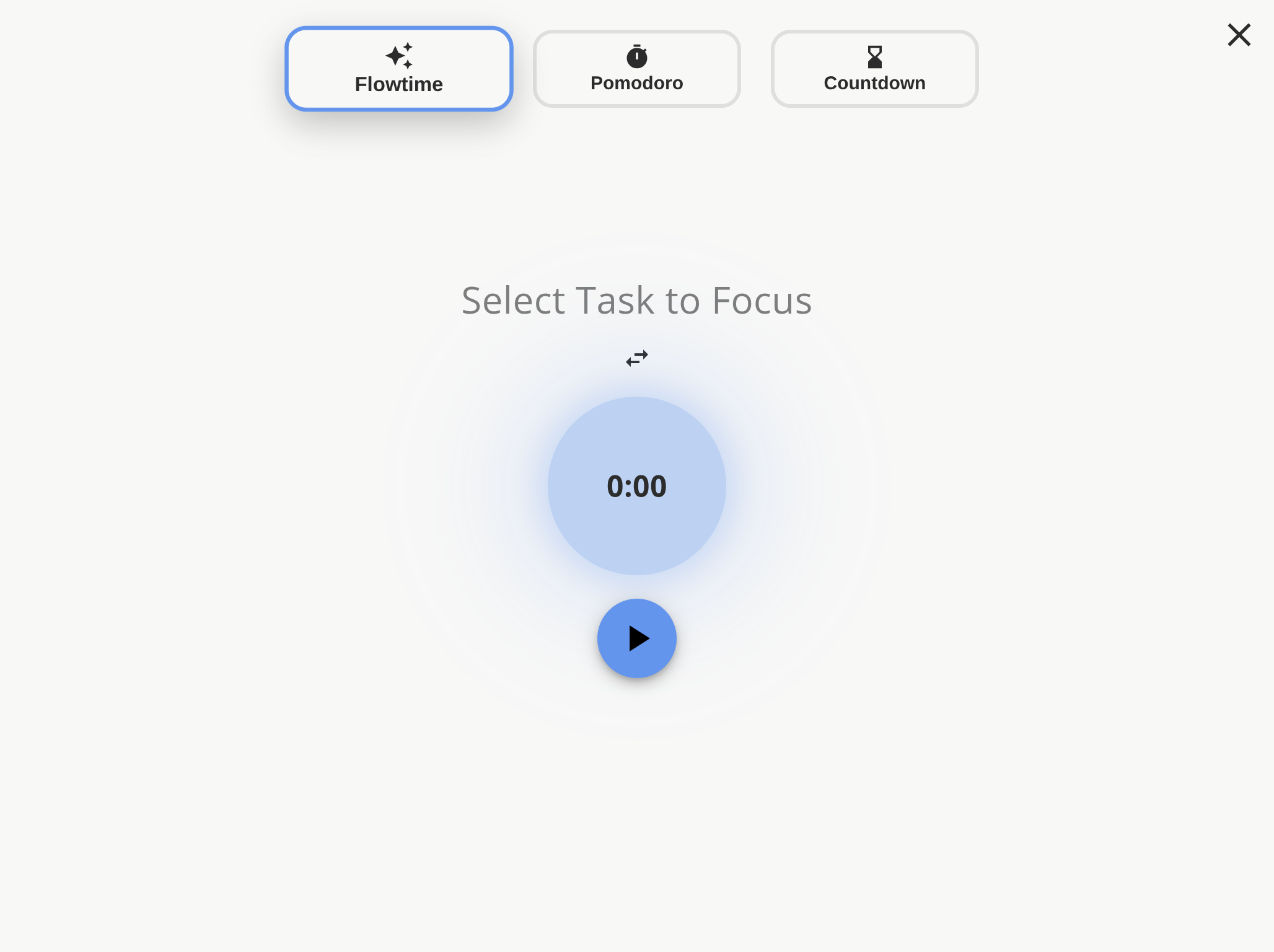
Super Productivity gives hyperfocus both a launch pad and a set of guardrails, free and open source. Focus Mode strips the screen down to a single task with a built-in timer – Pomodoro, a fixed countdown, or open-ended flowtime – which lowers the barrier to start and gives you the external hard-stop you cannot generate internally.
Underneath, time tracking runs automatically, so a hyperfocus session becomes data: you can see, after the fact, exactly where four hours went and whether it was the task you chose. Pair that with the scheduled planner view to bookend your blocks with real commitments, and you get the structure that turns an unpredictable attention spike into something you can aim deliberately.
Next Moves
- Before your next deep block: Pick the single task on paper first, then start a timer. Let hyperfocus find the thing you chose.
- Set one external exit: A hard-stop alarm or a meeting right after. Internal awareness will not save you mid-session.
- Review your logs Friday: Which tasks pulled you into useful hyperfocus, and which were traps? Aim for the first kind on purpose next week.
Hyperfocus is not the enemy of an ADHD work life – it is one of its sharpest tools. It just needs a target and a fence.
Related Resources
- ADHD Productivity Guide — the full routine hyperfocus fits into
- Visual Task Management for ADHD — choosing the right target before you lock in
- Flow State for Developers — the chosen cousin of hyperfocus
- Escaping the Dopamine Trap — the reward wiring underneath both
Footnotes
Hupfeld, K. E., Abagis, T. R., & Shah, P. (2019). Living “in the zone”: hyperfocus in adult ADHD. ADHD Attention Deficit and Hyperactivity Disorders, 11(2), 191-208. ↩
Frequently Asked Questions
What is ADHD hyperfocus?
Hyperfocus is a state of intense, sustained concentration on an engaging task, common in people with ADHD. While in it, you can lose track of time, hunger, and surroundings. It is not the opposite of an attention deficit – it is the same inconsistent attention system locking onto something stimulating rather than something chosen.
Is ADHD hyperfocus good or bad?
Both. Aimed at the right task it produces deep, high-output work most people rarely reach. Aimed at the wrong task – a tangent, a refactor nobody asked for – it burns hours and crowds out food, breaks, and deadlines. The skill is steering it, not summoning more of it.
How do I trigger hyperfocus on demand?
You usually cannot force it, but you can raise the odds: remove interruptions, pick a task with a clear, stimulating goal, work at your natural energy peak, and start a timer to lower the activation barrier. Hyperfocus tends to follow engagement, so making it easy to start is more reliable than trying to will it on.
How do I get out of hyperfocus before I burn out?
Use external interrupts, because internal awareness shuts off during hyperfocus. Set hard-stop alarms, schedule the next commitment right after the block, keep water and food in reach, and write a one-line "next step" note before you stop so re-entry is cheap.
Related resources
Keep exploring the topic
ADHD & Focus Patterns
Build gentle routines, dopamine-aware reminders, and quiet work blocks that actually stick.
Read moreADHD-Proofing Your Developer Workflow
Actionable strategies for neurodivergent developers to stabilize focus, protect energy, and build sustainable momentum without masking.
Read moreADHD Dopamine Menu: Examples and a Simple Setup Plan
Many people with ADHD seek stimulation, not suppression. A dopamine menu can give you lower-risk options when focus wanes – before you end up 40 minutes deep in social media.
Read moreStay in flow with Super Productivity
Plan deep work sessions, track time effortlessly, and manage every issue with the open-source task manager built for focus. Concerned about data ownership? Read about our privacy-first approach.

About the Author
Johannes is the creator of Super Productivity. As a developer himself, he built the tool he needed to manage complex projects and maintain flow state. He writes about productivity, open source, and developer wellbeing.