


· Productivity · 6 min read
Timeboxing: The #1 Productivity Technique (Research)
Timeboxing – assigning a fixed time limit to each task before you start – was ranked as the most useful technique in a Harvard Business Review analysis of 100 productivity methods1. It works as a practical constraint: it counters Parkinson’s Law, creates a clear commitment point, and helps prevent tasks from expanding to fill all available time.
This article breaks down the science behind timeboxing and gives you actionable strategies to start immediately. For a complete practical guide, see our Time Boxing Method Guide.
What Is Timeboxing?
At its core, timeboxing means assigning a fixed, pre-determined amount of time to a task – and sticking to it. Unlike traditional to-do lists, where tasks can sprawl endlessly, timeboxing imposes a healthy constraint that encourages focus and closure.
This principle connects directly to Parkinson’s Law, famously stated in The Economist in 19552:
“Work expands so as to fill the time available for its completion.”
By giving tasks deliberate time limits, you prevent them from ballooning and consuming more energy than they should.
Why Timeboxing Works (According to Research)
1. It Improves Decision-Making
A 2022 study in Scientific Reports found that time pressure pushes people to:
- Simplify decision-making by favoring habitual strategies
- Reduce uncertainty-directed exploration – repeating familiar choices rather than seeking new options (note: the study used bandit tasks measuring exploration/exploitation behavior; effects on real-world focused work are inferred)
- Make faster decisions – even if they sacrifice minor rewards3
2. It Reduces Procrastination Through Deadlines
The evidence here is nuanced: chronic time pressure is harmful, but specific short-term deadlines or precommitments can sometimes reduce open-ended procrastination when used sparingly4.
(Note: research on chronic time pressure supports caution, not constant urgency. Benefits are more plausible when the constraint is brief, controlled, and chosen in advance.)
3. It Lowers Cognitive Overload
Breaking projects into time-limited blocks makes work feel more approachable:
- Large tasks become less overwhelming
- Progress is easier to measure
- Mental energy shifts from over-planning to actually executing
4. It Can Boost Performance – When Balanced
A 2022 pilot case study in the International Journal of Environmental Research and Public Health found that time pressure affected psychotechnical test performance5. Broader evidence suggests effects vary by task, pressure level, and duration. In practice, moderate constraints may help by:
- Reducing overthinking
- Sharpening focus
- Encouraging better prioritization5
However, too much pressure reverses these benefits.
What Happens in Your Brain During Timeboxing?
Direct neuroscience studies on timeboxing are still emerging, so it is better to treat the brain story as an inference from adjacent attention and stress research:
- Sharper attention: A clear time limit gives your attention a boundary and reduces the temptation to keep re-deciding what the task is.
- Eustress vs. distress: Moderate constraints can feel motivating; excessive constraints become stressful and counterproductive.
- Reduced decision load: By deciding time limits in advance, you avoid countless micro-decisions, preserving mental bandwidth for deep work.
Timeboxing in Action: Who Uses It?
- Elon Musk has been described as using structured time blocks, though public claims about exact five-minute increments are inconsistent6.
- Bill Gates’ “Think Weeks” are scheduled retreats for focused reading and reflection; they are a broader example of protected focus time, not evidence of strict timeboxing7.
- Cal Newport, author of Deep Work, is a vocal advocate of time-blocked scheduling.
Organizations also embrace timeboxing:
- Basecamp has described 4-day “Summer Hours” as a seasonal constraint that forces prioritization8.
- Agile teams commonly use timeboxed sprints for product development.
- Microsoft’s Work Trend Index has reported workplace changes around meeting length and focus time, but exact productivity effects vary by team and should not be treated as universal9.
How to Timebox with Super Productivity
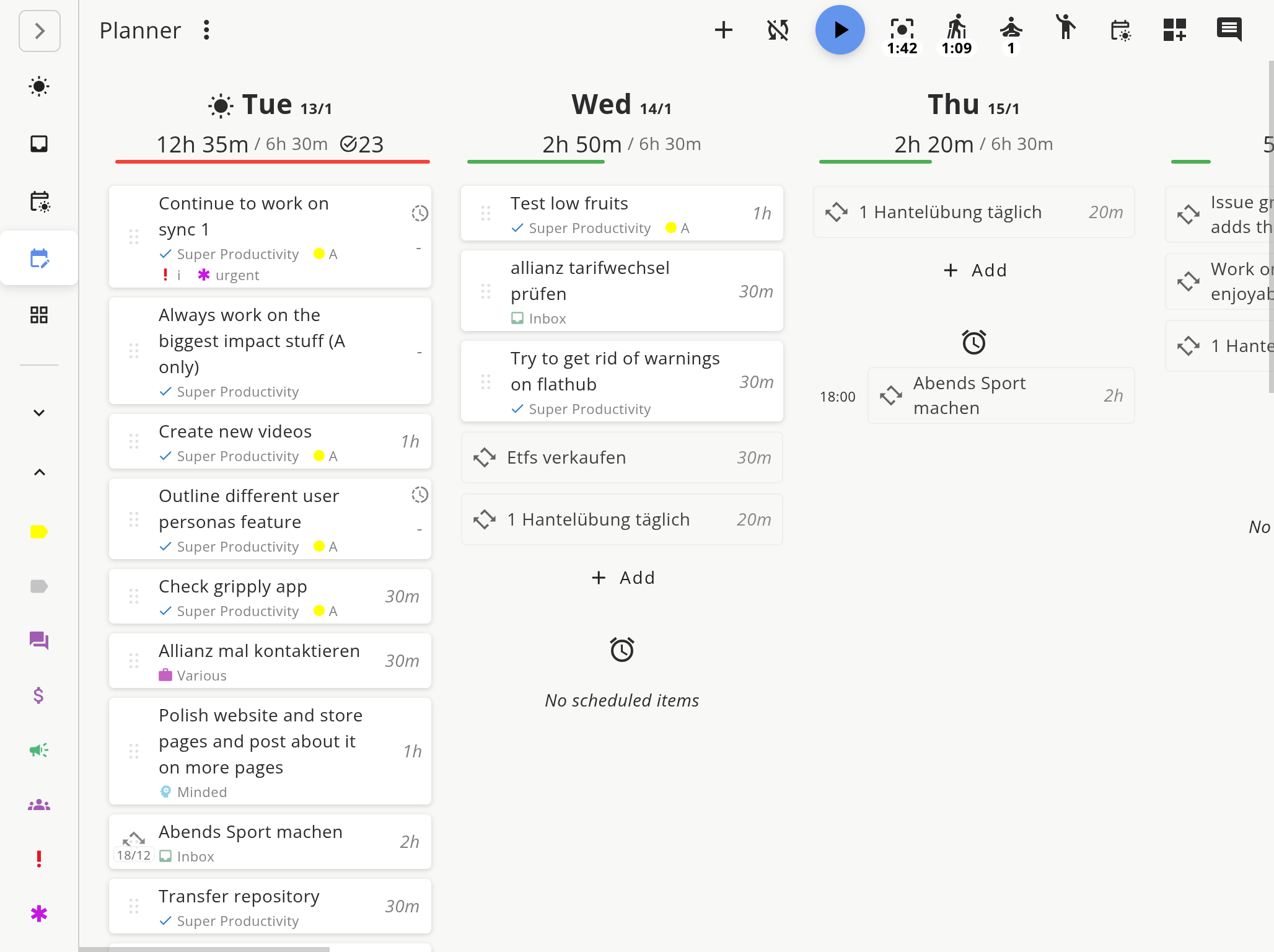
Super Productivity makes timeboxing simple with its short syntax. Just type your task and add a time estimate:
Write project proposal 2h
Review code changes 45m
Team standup meeting 15m
Advanced Approaches
- Pomodoro-Style Blocks:
Study React hooks 25m
Break 5m
Practice React hooks 25m- Batching Similar Tasks:
Email responses 30m
Slack messages 15m
Phone calls 45m
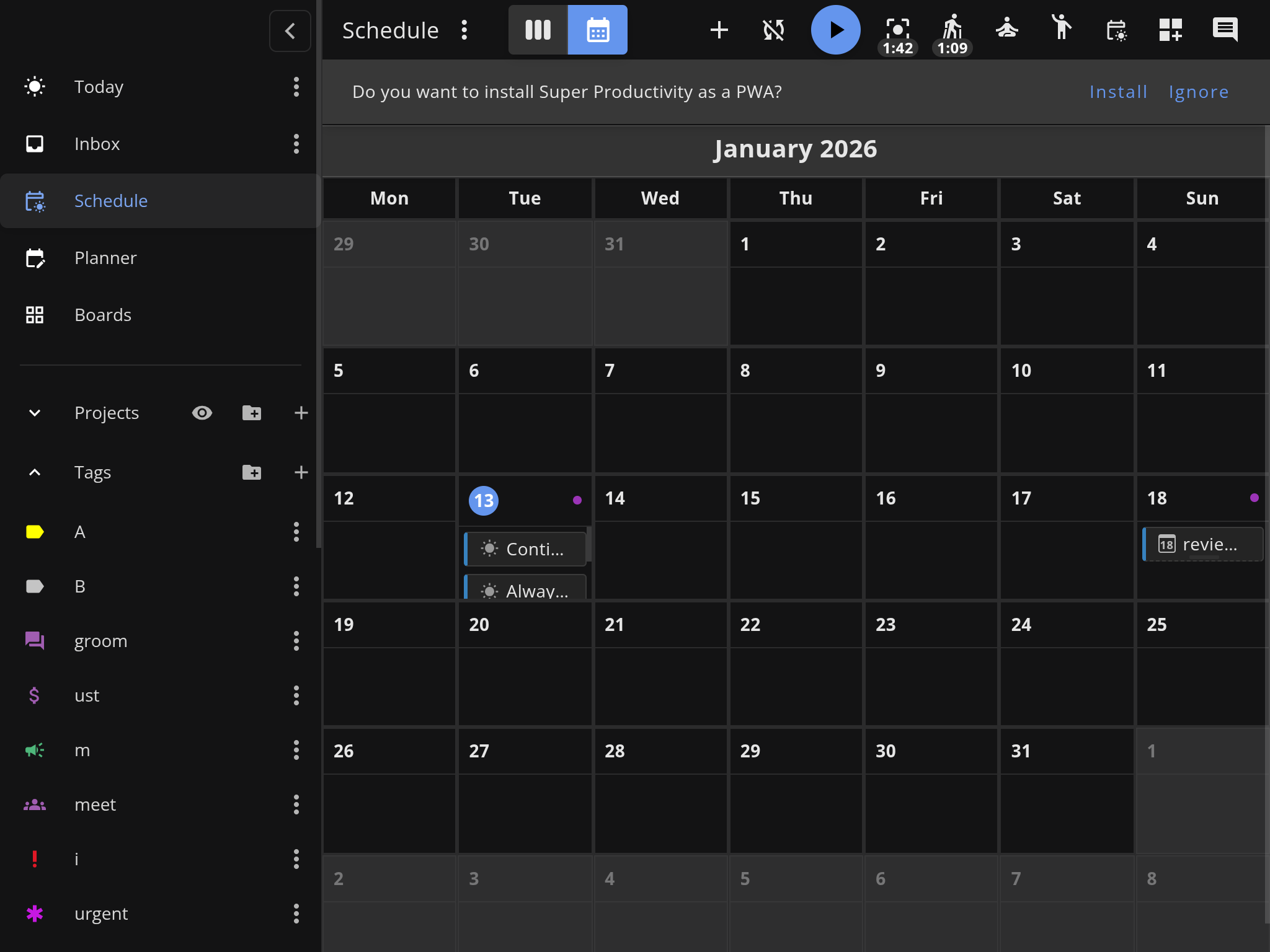
Super Productivity also helps you see if your planned tasks fit into your available time automatically.
Best Practices to Get the Most Out of Timeboxing
Start with Generous Estimates People typically underestimate by 20-40%. Add a 25% buffer and refine as you collect real data.
Protect Your Timeboxes Turn off notifications, set boundaries, and use Super Productivity’s break reminders.
Prioritize Progress Over Perfection Focus on moving the task forward, not perfecting every detail.
Review Weekly Check where your estimates were off and adjust.
Avoid These Common Pitfalls
- Over-Scheduling: Leave at least 20% of your day unplanned for unexpected issues.
- Being Too Rigid: Timeboxes are guides, not prisons – adjust if priorities shift.
- Estimation Anxiety: Don’t obsess over accuracy; estimation improves with practice.
Putting It All Together: Your First Week with Timeboxing
- Install Super Productivity.
- Plan tomorrow’s top 3-4 tasks with time estimates.
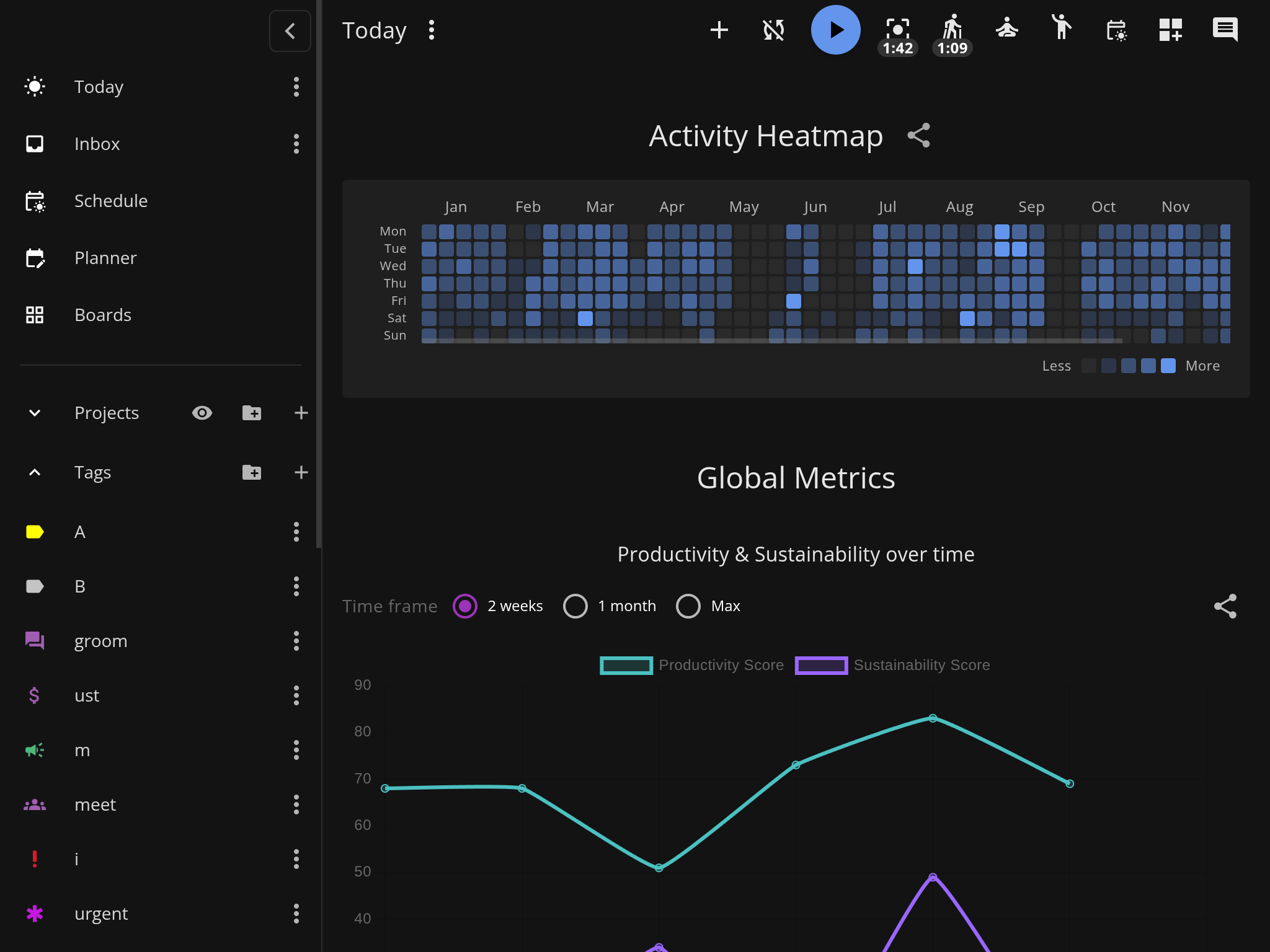
- Track how your estimates compare to actual time spent.
- Adjust your approach at the end of the week.
- Iterate – your accuracy and flow will improve over time.
The Bottom Line
Timeboxing works because it taps into how our brains handle constraints. It sharpens focus, reduces procrastination, and makes large projects manageable.
Super Productivity’s lightweight, syntax-driven approach removes friction – no complex systems, just fast time estimates and structured schedules.
Start small. Be consistent. Use the science of timeboxing to regain control of your workday – and your sanity.
Want to see how effortless timeboxing can be? Download Super Productivity and create your first timeboxed tasks today. Join thousands of users already turning research into results. To make this a habit, read our full Time Boxing Method Guide.
References
Footnotes
Zao-Sanders, M. (2018, December). How Timeboxing Works and Why It Will Make You More Productive. Harvard Business Review. Link ↩
Parkinson, C. N. (1955). Parkinson’s Law. The Economist. ↩
Wu, C. M., Schulz, E., Pleskac, T. J., & Speekenbrink, M. (2022). Time pressure changes how people explore and respond to uncertainty. Scientific Reports, 12(1), 4122. https://doi.org/10.1038/s41598-022-07901-1 ↩
Denovan, A., & Dagnall, N. (2019). Development and Evaluation of the Chronic Time Pressure Inventory. Frontiers in Psychology, 10, 2717. https://doi.org/10.3389/fpsyg.2019.02717. For self-imposed deadlines and precommitment, see Ariely, D., & Wertenbroch, K. (2002). Procrastination, Deadlines, and Performance: Self-Control by Precommitment. Psychological Science, 13(3), 219-224. https://doi.org/10.1111/1467-9280.00441 ↩
Korban, Z., & Taraszkiewicz-Lyda, M. (2022). The Impact of Time Pressure on the Results of Psychotechnical Tests. International Journal of Environmental Research and Public Health, 19(22), 14724. https://doi.org/10.3390/ijerph192214724 ↩ ↩2
Musk, E. Comments on time management practices via interviews and Twitter/X. ↩
Interviews and articles documenting Bill Gates’ Think Weeks (e.g., The New York Times, GatesNotes). ↩
Niles, K. (2017). Why we only work 4 days a week during summer. Signal v. Noise (Basecamp blog). ↩
Microsoft Work Trend Index (2023). Use workplace trend data as context, not as proof that a specific meeting policy will produce the same productivity increase in every organization. ↩
Related resources
Keep exploring the topic
Timeboxing & Scheduling Guide
Blend buffer blocks, timeboxing, and daily reviews so your calendar and task list stay in sync.
Read moreTimeboxing vs Time Blocking: What Is the Difference?
Timeboxing and time blocking sound similar but work differently. Time blocking reserves calendar slots for types of work. Timeboxing assigns fixed durations to specific tasks. Here's when to use each.
Read moreCalendar Blocking vs. To-Do Lists: The Hybrid That Works
Pure calendar blocking is fragile. Pure to-do lists ignore time. Here's how combining both approaches fixes the flaws of each – and why timeboxing is the bridge.
Read moreStay in flow with Super Productivity
Plan deep work sessions, track time effortlessly, and manage every issue with the open-source task manager built for focus. Concerned about data ownership? Read about our privacy-first approach.

About the Author
Johannes is the creator of Super Productivity. As a developer himself, he built the tool he needed to manage complex projects and maintain flow state. He writes about productivity, open source, and developer wellbeing.